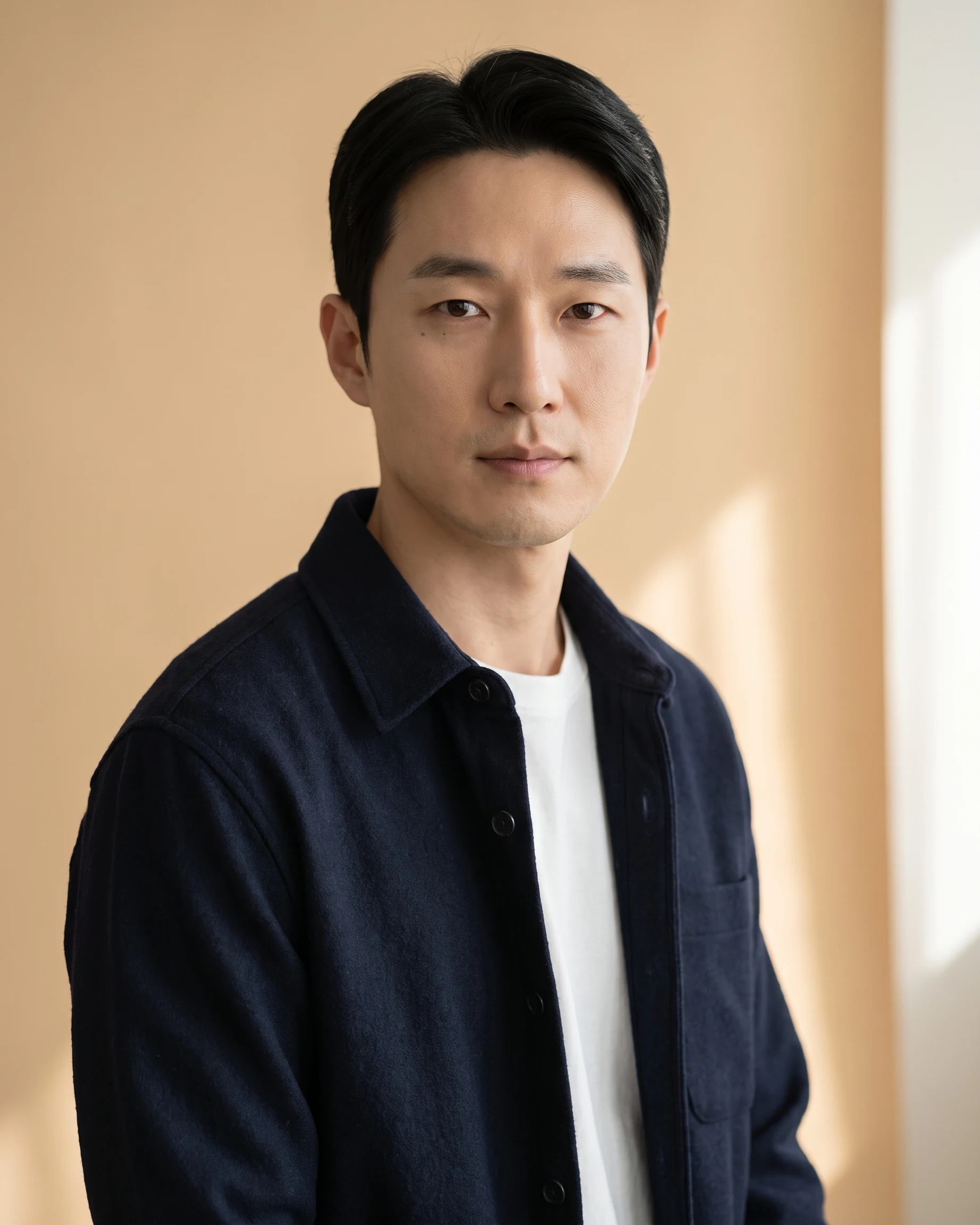
BIOGRAPHY
The story behind the actor.
Growing up
Growing up in Suwon, Tae-o watched his father listen to customers to the end before fixing their bicycles. He did not pick up a tool until the customer had finished explaining where the noise came from, and beside him Tae-o learned to listen. In his mother's photo studio he watched people freeze in front of the camera, and learned that their faces relax once you get them talking. Among friends Tae-o was the good listener, so stories gathered around him. The problem was that once he had heard everything, he was late to start saying anything himself. When his brother, five years younger, said, "You listen to everything and then say nothing," Tae-o realized for the first time that listening is not the same as answering.
Why acting
In his high school broadcasting club Tae-o filmed interviews, and liked filming the face of the listener more than the speaker. Entering a theatre and film program in 2010, he was assessed on his reactions more than his lines. His professor said his listening face brought his partners' lines alive — and pointed out at the same time that the face disappeared when he began his own lines. In a reaction course after graduating, scaling his listening face down to screen size, he learned that listening and answering must sit inside a single breath. Tae-o says that is still the hardest thing.
Turning points
In a two-person scene in his reaction course in 2021, Tae-o listened to his partner's long speech to the end and left two beats empty while preparing his next line. His partner read that gap as agreement and moved the scene on, and Tae-o's line never came out. When his partner said afterwards, "You didn't say anything, so I moved on," Tae-o answered that he had been preparing, and realized that the other person could not see that. A listening face is visible, but a preparing face looks like silence. Since then Tae-o has decided to say something first — even just "wait" — before his answer is ready. The habit of wanting a beat's rest after listening to everything is still there.
PERSONALITY & CRAFT
Character and craft.
Up close
He speaks slowly and his expression is gentle. It seems he will listen to anything to the end, so stories gather around him, but some people are frustrated at how late his answers come.
At home he tunes up bicycles and sorts his film photos. On the phone with his brother, he actually talks a lot. When tired he only listens and puts off answering.
Preparing a scene
On a first read he writes in one line what the character does after listening. For every listening beat he decides to move only one of his eyes, mouth or hands. For two-person scenes he agrees in advance with his partner on where he will come in.
He is quiet while waiting, but says it is his turn when his partner is about to move on. Between takes he tells them in one line what he is preparing.
The texture of the acting
- While listening, only the focus of his eyes changes, showing where the other person's words land.
- He takes a line back briefly in a low, slow voice so it sounds sincere.
- When surprised his words come late, and the delay reads not as acting but as a person.
A day off stage
In the morning he rides his bicycle along the riverside and takes film photos of people talking. Back home he cleans the chain and sorts his photos. In the evening, on the phone with his brother, he checks with himself whether there was a time this week when he listened to everything and said nothing.